You've decided to install a propane generator system for your Puerto Rico home or business. The next decision — one that many people overlook until they're deep in the planning process — is whether to install an above-ground or underground propane tank.
Both options work equally well as a fuel source for your generator. Both are installed and serviced by Tropigas to NFPA 58 standards. But they differ significantly in cost, aesthetics, installation complexity, maintenance requirements, and suitability for Puerto Rico's specific environment.
This guide breaks down every factor so you can make the right choice for your property.
Above-Ground Propane Tanks
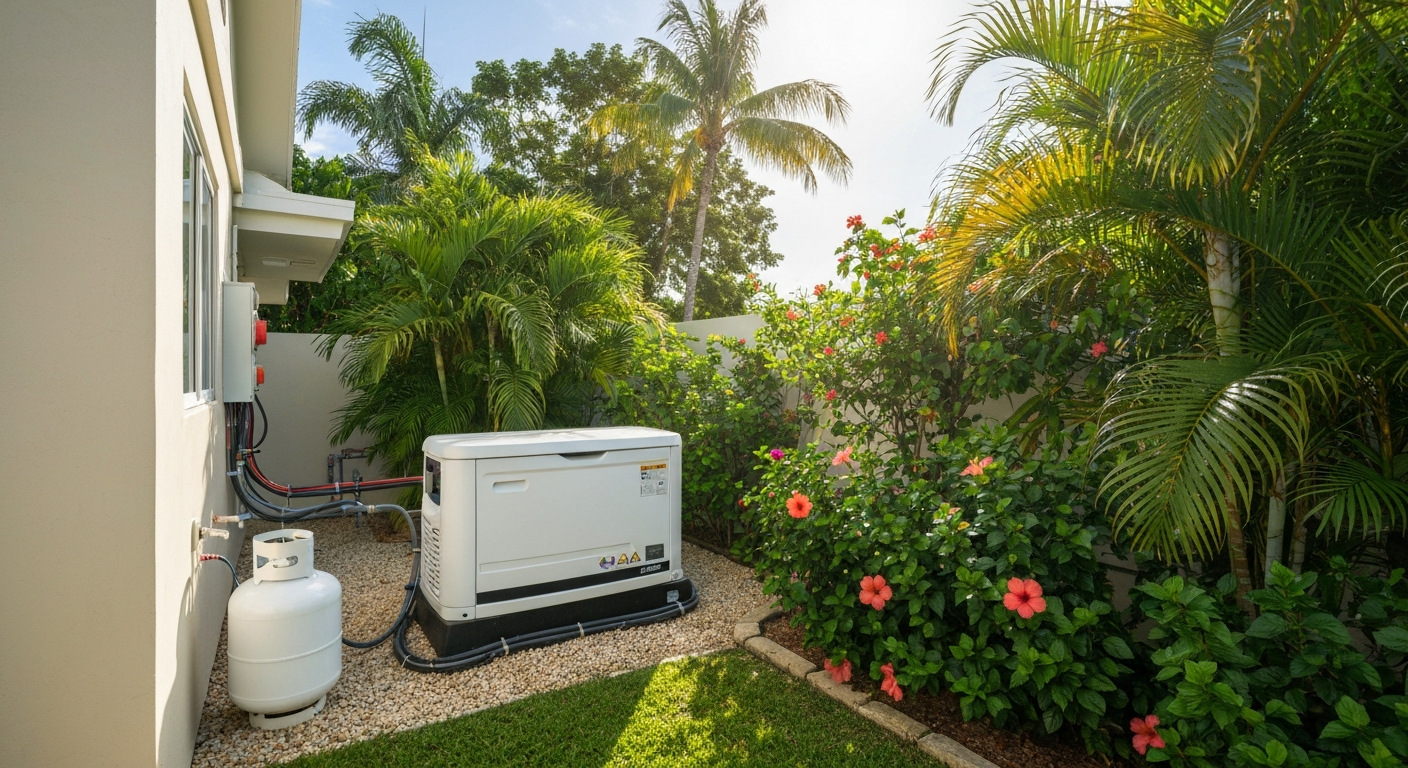
Above-ground tanks are the most common residential propane tank configuration in Puerto Rico. They sit on the surface of your property — typically on a concrete pad or gravel base — and are highly visible.
Characteristics:
- Installed on the surface of your property
- Visible from the yard and potentially from the street
- Generally white or silver in color
- Easier to inspect and maintain
- Lower installation cost
- Faster installation — typically 1 to 2 days
- Available in all standard capacities: 120, 250, 500, 1,000+ gallons
- Standard configuration for residential propane in Puerto Rico
Underground Propane Tanks
Underground tanks are buried below grade — only the dome and fill valve are visible above the ground surface. They provide fuel storage that's essentially invisible from the yard and completely invisible from the street.
Characteristics:
- Buried below grade — only dome visible
- Nearly invisible — maintains property aesthetics
- Protected from direct sun exposure and surface weather
- More complex installation — excavation required
- Higher installation cost
- Longer installation timeline — 3 to 5 days
- Available in standard capacities: 250, 500, 1,000+ gallons
- Special coating required to protect from soil corrosion
The Key Differences — Side by Side
| Factor | Above-Ground | Underground |
|---|---|---|
| Visibility | Fully visible | Only dome above ground |
| Aesthetics | Prominent feature in yard | Nearly invisible |
| Installation cost | Lower | Higher |
| Installation time | 1–2 days | 3–5 days |
| Excavation required | No | Yes |
| Inspection ease | Easy — visual inspection | Requires gauge reading |
| Corrosion risk | Salt air exposure | Soil corrosion (special coating) |
| Sun exposure | Direct — affects temperature | None |
| Hurricane physical protection | Exposed to debris | Protected below grade |
| Property value impact | Neutral to slight negative | Neutral to slight positive |
| Minimum sizes available | 120 gallons | 250 gallons |
| NFPA 58 clearance from buildings | 10 feet (120–500 gal) | 10 feet |
Round 1: Aesthetics & Property Value
This is the factor that drives most people toward underground tanks — and it's a legitimate consideration.
Above-ground: A 500-gallon above-ground propane tank is a significant visual feature in your yard. It's roughly the size of a large SUV lying on its side. In a well-landscaped Puerto Rico property, a large white tank can be an aesthetic challenge — though strategic landscaping with plants and fencing can minimize its visual impact.
Underground: An underground tank is essentially invisible. From the yard, you see only a small domed cover — typically painted to blend with the landscape — and a fill port. From the street, you'd have no idea a propane tank exists on the property at all.
For properties with significant landscaping investment, high-end homes, or lots where the tank placement would be highly visible from the street or neighbors, the aesthetic advantage of underground installation is meaningful.
Round 2: Installation Cost
Above-ground: Above-ground tank installation is straightforward. The tank is delivered, set on a prepared concrete pad or gravel base, and connected to your propane system. Total installation cost for a 500-gallon above-ground tank in Puerto Rico typically ranges from $800 to $1,500 for the tank placement, not including the gas line run to your generator.
Underground: Underground installation requires excavation, specialized tank preparation (cathodic protection coating to prevent soil corrosion), careful backfilling, and compaction. Total installation cost for a 500-gallon underground tank typically runs $1,500 to $3,000 — roughly double the above-ground cost for the same capacity.
Round 3: Puerto Rico's Climate Considerations
Puerto Rico's tropical environment creates specific considerations for both tank types that don't apply in cooler, drier mainland climates.
Salt air and coastal corrosion: Puerto Rico's coastal environment exposes above-ground tanks to salt air — a significant corrosion accelerant. Above-ground tanks must be inspected more frequently for surface corrosion, and paint integrity must be maintained. Tropigas uses tanks with appropriate coatings for Puerto Rico's coastal environment, but annual inspections are particularly important for properties near the coast.
Underground tanks face a different corrosion challenge — soil corrosion. All underground tanks installed by Tropigas include cathodic protection — a sacrificial anode system that prevents electrochemical corrosion from the soil. This protection is highly effective and is a standard component of underground installations.
Temperature effects: Above-ground tanks in Puerto Rico's tropical sun experience significant temperature variation. Propane pressure varies with temperature — higher temperatures mean higher pressure. Tanks are designed to handle this, but direct sun exposure is a consideration for very large above-ground installations. Underground tanks maintain more stable temperatures year-round.
Hurricane physical protection: During a hurricane, above-ground tanks are exposed to flying debris, high winds, and potential impact. A properly anchored above-ground tank is safe — Tropigas installs tanks with appropriate anchoring for Puerto Rico's hurricane environment — but underground tanks have an inherent physical protection advantage from being below grade.
Round 4: Inspection & Maintenance
Above-ground: Above-ground tanks can be visually inspected at any time. You can see the tank, check the gauge, look for rust or damage, and verify the regulator and connections visually. Annual Tropigas maintenance visits are easy to perform because everything is accessible.
Underground: Underground tanks require gauge reading to check fuel level — you can't see the tank itself. Leak detection relies on monitoring fuel consumption patterns and periodic professional inspection. The tank itself cannot be visually inspected without excavation, though the dome connections and regulator are accessible.
For leak detection and routine maintenance, above-ground tanks are simpler. However, underground tanks with scheduled deliveries — available from Tropigas — eliminate the need for manual gauge checks.
Round 5: Minimum Tank Size
Above-ground: Available in all standard sizes from 120 gallons up — making above-ground the right choice for homes that only need a small tank for a stove and water heater without a generator.
Underground: Typically available starting at 250 gallons. The minimum size for underground installation is larger because the excavation cost makes very small underground tanks economically impractical.
For generator applications specifically, both tank types are available in the sizes you need — 250, 500, and 1,000+ gallons. This factor primarily matters for non-generator residential applications.
Which Is Right for Your Generator System?
Choose above-ground if:
- Budget is a primary consideration
- You need installation completed quickly
- Your property has space where the tank won't be prominently visible
- You prefer easier visual inspection and maintenance access
- You need a 120-gallon tank (smallest practical generator tank)
- Your property layout makes excavation difficult or costly
Choose underground if:
- Property aesthetics are a priority
- Your lot has limited space and a surface tank would be highly visible
- You're in a high-end residential neighborhood where aesthetics matter
- Your homeowners association or municipal ordinances restrict above-ground tanks
- You want maximum physical protection from hurricane debris
- You're willing to invest in a longer-term installation
⚡ The Bottom Line for Puerto Rico
For most Puerto Rico generator installations, above-ground tanks are the most common choice for practical reasons — lower cost, faster installation, and easier maintenance. The visual impact can be mitigated with strategic landscaping. Underground tanks are the right choice when aesthetics are a genuine priority or when property layout makes surface installation impractical.
NFPA 58 Clearance Requirements
Regardless of which tank type you choose, Puerto Rico's propane installations must comply with NFPA 58 minimum clearance requirements:
| Tank Capacity | From Buildings/Openings | From Property Lines |
|---|---|---|
| Up to 125 gallons | 10 feet | 10 feet |
| 126–500 gallons | 10 feet | 10 feet |
| 501–2,000 gallons | 25 feet | 25 feet |
Tropigas engineers identify the compliant placement for your specific tank size and property layout during your free site evaluation. We handle all permitting requirements based on your municipality's regulations.
Tropigas Installs Both — Across All 78 Municipalities
Whether you choose above-ground or underground, Tropigas installs and services propane tank systems across all 78 municipalities of Puerto Rico. With 23 distribution plants island-wide and a private Maritime Terminal in Guaynabo, we guarantee supply continuity for your generator system regardless of which tank configuration you choose.
Call 787-641-8002 for a free site evaluation. Our engineers will assess your property, recommend the optimal tank placement and configuration, and provide a complete cost estimate with no obligation.
Ing. Rodolfo Leo Quiñones
Operations, Sales and Export Manager — Tropigas / Tropigas SXM
Expert in propane energy systems, NFPA compliance, and industrial gas logistics in Puerto Rico and the Caribbean.