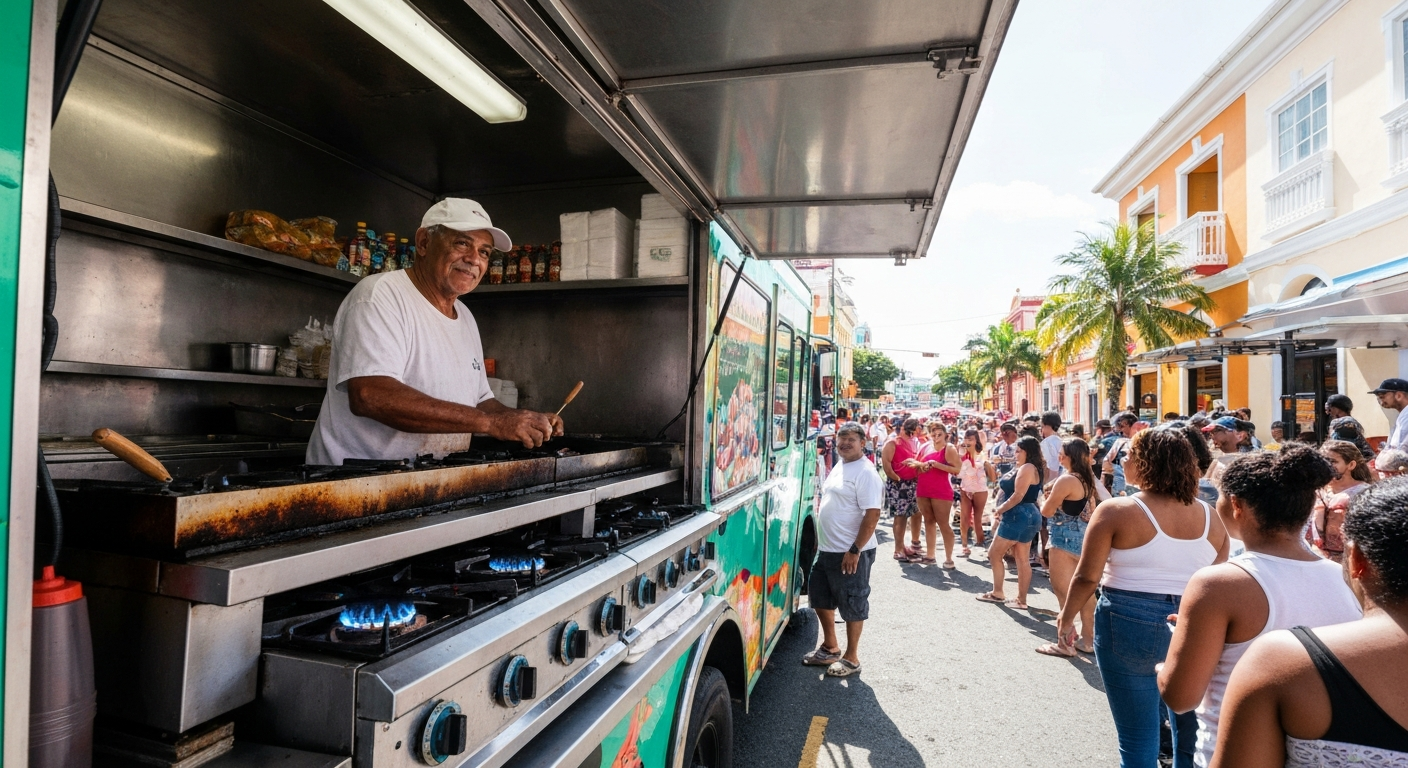
Puerto Rico's food truck scene has exploded. From the food truck parks of San Juan to weekend festivals in Ponce, from beach kiosks in Luquillo to highway stops in Guayanilla, mobile kitchens have become one of the most dynamic segments of the island's food service industry.
Every one of those food trucks runs on propane. There is no practical alternative for mobile kitchen operations. Propane delivers the high-BTU cooking performance that professional mobile kitchens demand, in a portable fuel format that travels with your operation, with a supply network, Tropigas's 23 distribution plants across Puerto Rico, that means you're never far from a refill.
Why Every Puerto Rico Food Truck Runs on Propane
No alternative delivers the same performance: Commercial cooking requires high-BTU burners that can sustain intense heat for extended periods. Propane burners deliver 15,000 to 30,000+ BTU per burner, the heat output professional cooking demands.
Mobility that matches your operation: Your food truck moves. Your fuel moves with it. Propane cylinders are portable, standardized, and refillable at any of Tropigas's 23 plants across Puerto Rico.
Independence from the grid: Food trucks operate at locations without reliable electrical infrastructure. Propane powers your kitchen completely independently of any grid connection.
Puerto Rico's supply network: With 23 Tropigas plants from Isabela to Yabucoa, there's always a refill location near your operating area.
Food Truck Propane System Components
Propane cylinders: Most food trucks operate with one or two 100-pound cylinders in a manifold configuration. This provides adequate capacity for a full day of service without mid-service refueling.
Cylinder manifold: A manifold connects two cylinders to your cooking system simultaneously or in sequence, allowing switching between cylinders without interrupting cooking if one runs low.
Regulator: The regulator reduces propane pressure from the high pressure in the cylinder to the working pressure your cooking equipment requires. Food truck regulators must be sized for the total BTU demand of all connected equipment operating simultaneously.
Gas line system: Internal gas lines connecting the regulator to each piece of cooking equipment must be properly sized, secured, and protected from damage in the mobile environment.
Safety shutoffs: A master shutoff valve accessible from outside the truck allows emergency shutdown of the entire gas system without entering the kitchen.
⚡ Ready to Set Up Your Food Truck?
Get your food truck propane system professionally designed, installed, and certified for health department compliance.
Call 787-641-8002Health Department and Fire Safety Compliance
Key compliance requirements:
- NFPA 58 compliance: All propane storage and handling on your food truck must comply with NFPA 58, including proper cylinder securing, cylinder quantity limits per vehicle type, and required clearances from ignition sources.
- NFPA 54 compliance: All gas piping inside your food truck must comply with NFPA 54, including proper pipe sizing, required shutoff valves, and flexible connector specifications.
- Cylinder securing: Cylinders must be secured to prevent movement during vehicle operation.
- Ventilation: Food truck kitchens must have adequate ventilation for combustion air supply and exhaust removal.
- Leak testing: Before operating any new or modified propane system, a complete leak test must be performed. Tropigas certifies food truck propane systems and issues documentation for health department permit applications.
- Annual inspection: Most health department operating permits require annual safety inspection of the propane system.
Setting Up Your Food Truck Propane System
For a new food truck:
- Step 1: Equipment list and BTU calculation. List every piece of cooking equipment and its BTU rating. This total determines your regulator size, cylinder capacity, and gas line sizing.
- Step 2: System design. Tropigas reviews your equipment list and designs the propane system, including cylinder configuration, manifold setup, and regulator specifications.
- Step 3: Installation and certification. A certified Tropigas technician inspects your installed system, performs a complete leak test, and issues certification documentation.
- Step 4: Health department permit. Submit your Tropigas certification documentation with your health department operating permit application.
- Step 5: Cylinder supply setup. Identify your primary and backup Tropigas plants for cylinder refills based on your operating schedule.
For an existing food truck: If you have an existing food truck with a propane system that has never been professionally inspected or certified, call 787-641-8002 to schedule an inspection.
Cylinder Supply for Food Trucks
Tropigas supplies and refills propane cylinders for food truck operations at all 23 distribution plants across Puerto Rico.
Available cylinder sizes for food trucks:
- 20-pound cylinders for small operations or as backup cylinders.
- 100-pound cylinders, the standard for most food truck operations.
- Larger cylinders by special arrangement for high-volume operations.
Planning your refill schedule: Most food trucks operating 5 to 7 days per week refill cylinders 1 to 3 times per week. Tropigas recommends refilling when cylinders reach 25% to 30% capacity, never waiting until empty.
Frequently Asked Questions
How many propane cylinders does a food truck need in Puerto Rico?
Most food trucks operate with two 100-pound cylinders in a manifold, providing approximately 6 to 12 hours of full-service cooking capacity depending on equipment and intensity of use.
How often does a food truck need to refill propane in Puerto Rico?
Operating 6 to 8 hours per day, most operators refill two 100-pound cylinders every 2 to 4 days. High-volume operations may refill daily.
Does Tropigas certify food truck propane systems for health department permits?
Yes. Tropigas performs safety inspections and issues official certification documentation accepted by Puerto Rico's Department of Health and municipal inspection authorities.
Can I refill my cylinders at any Tropigas plant in Puerto Rico?
Yes. All 23 Tropigas distribution plants refill standard propane cylinders. Find your nearest plant at tropigaspr.com/plantas.
What happens if my cylinder runs out during service?
With a two-cylinder manifold, your system automatically switches to the backup cylinder when the primary runs low, giving you time to swap the empty cylinder without interrupting service.
Ing. Rodolfo Leo Quiñones
Operations, Sales and Export Manager , Tropigas / Tropigas SXM
Expert in propane energy systems, NFPA compliance, and industrial gas logistics in Puerto Rico and the Caribbean.


