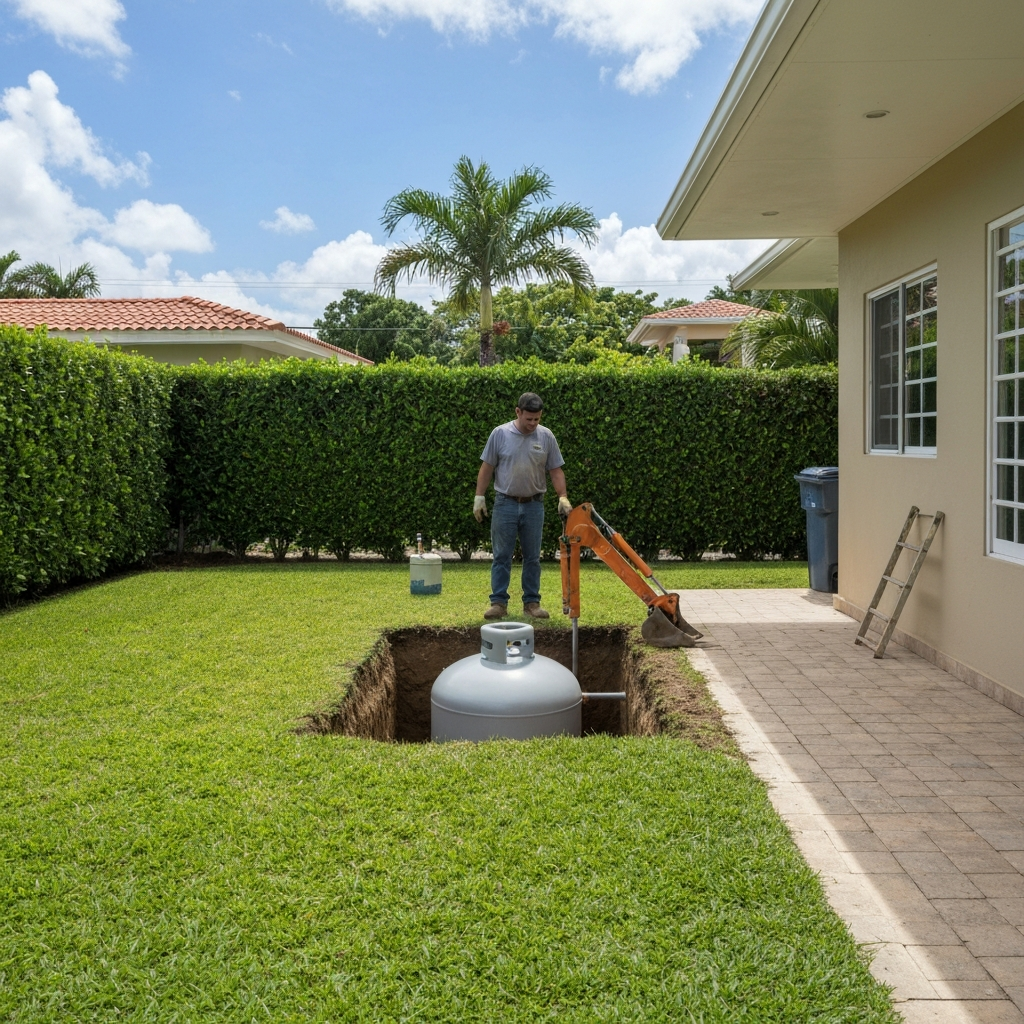
An underground propane tank provides all the fuel capacity of an above-ground tank with virtually none of the visual impact. For Puerto Rico homeowners who want energy independence and resilience but prefer to maintain their property's aesthetic, underground installation is the solution.
What Is an Underground Propane Tank?
An underground propane tank is installed below grade, buried in your yard with only a small dome and fill valve visible above the ground surface. Underground tanks are functionally identical to above-ground tanks. They store the same fuel at the same pressure, serve the same appliances, and are filled by the same Tropigas delivery trucks.
Benefits of Underground Installation in Puerto Rico
- Aesthetics: A 500-gallon above-ground propane tank is approximately the size of a large SUV lying on its side. Underground installation eliminates this visual element entirely.
- Hurricane debris protection: Underground tanks are protected from hurricane-force winds and flying debris by being below grade.
- Property value: Underground propane tanks have a neutral to slightly positive effect on property values. For high-end properties in San Juan's upscale neighborhoods, Guaynabo, or coastal municipalities, underground installation preserves property aesthetics and buyer appeal.
- Temperature stability: Underground tanks maintain more stable temperatures year-round than above-ground tanks exposed to Puerto Rico's tropical sun, resulting in more consistent propane pressure.
Considerations for Underground Installation
- Higher installation cost: Underground installation requires excavation, specialized tank preparation with cathodic protection coating, and careful backfill. Total installation cost for a 250-gallon underground tank is typically $1,500 to $3,000, approximately double the cost of a comparable above-ground installation.
- Minimum size: Underground propane tanks are typically available starting at 250 gallons. The excavation cost makes very small underground tanks economically impractical.
- Longer installation timeline: Above-ground installations take 1 to 2 days. Underground installations require 3 to 5 days due to excavation, tank preparation, and backfill requirements.
⚡ Cathodic protection: All Tropigas underground tank installations include cathodic protection, a sacrificial anode system that prevents electrochemical corrosion from soil contact, extending underground tank service life to 30 to 40 years.
Underground vs Above-Ground , Side by Side
| Factor | Underground | Above-Ground |
|---|---|---|
| Visual impact | Minimal, dome only | Prominent |
| Installation cost | $1,500 to $3,000 | $800 to $1,500 |
| Installation time | 3 to 5 days | 1 to 2 days |
| Minimum size | 250 gallons | 120 gallons |
| Hurricane protection | Protected below grade | Exposed, anchored |
| Temperature stability | More stable | Varies with climate |
| Service life | 30 to 40 years | 20 to 30 years |
The Underground Installation Process
- Step 1: Free site evaluation. Tropigas engineer visits your property to assess soil conditions and identify optimal tank placement per NFPA 58 clearances.
- Step 2: Underground utility marking (ORCOP) completed before any excavation.
- Step 3: Excavation to the appropriate depth and dimensions.
- Step 4: Tank preparation with cathodic protection and protective coatings before installation.
- Step 5: Tank lowering and positioning into the excavation per design specifications.
- Step 6: Backfill with clean sand or pea gravel that provides structural support without stressing the tank.
- Step 7: Gas line installation from the dome to your home and appliances.
- Step 8: Pressurized leak test and certification before first fill.
- Step 9: First fill and system activation.
Is Underground Right for Your Property?
Underground is right when: Your property has strong aesthetic standards. Your lot is small and above-ground placement would be uncomfortably close to living spaces. Your homeowners association restricts above-ground tanks. You want maximum hurricane protection.
Above-ground is right when: Budget is a primary consideration. You need the smallest practical tank size (120 gallons). Installation speed is important.
Ready to install your tank?
Call Tropigas for a free site evaluation and start the process today.
Call 787-641-8002Frequently Asked Questions
Ing. Rodolfo Leo Quiñones
Operations, Sales and Export Manager , Tropigas / Tropigas SXM
Expert in propane energy systems, NFPA compliance, and industrial gas logistics in Puerto Rico and the Caribbean.