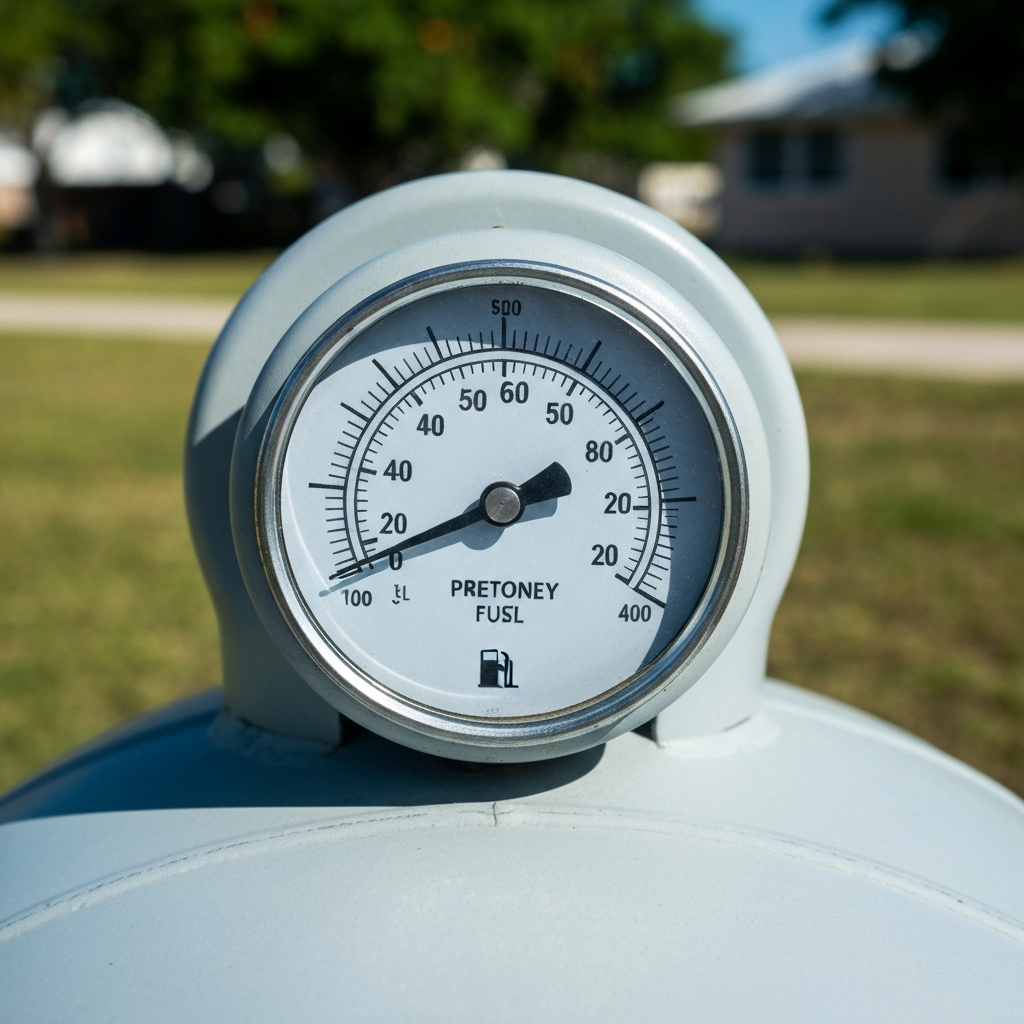
Your propane tank has a gauge on top that tells you exactly how full it is. Reading it correctly means you never run out of fuel unexpectedly, and you always know when to call Tropigas for a delivery.
Where to Find Your Gauge
The gauge is located in the dome of your propane tank, the rounded-sm metal cover on top. Open the dome by lifting or unscrewing the cover. Inside you will see a round dial with numbers from 5 to 95, similar to a car fuel gauge. The needle points to your current fuel level as a percentage of the tank's total capacity.
How to Read the Numbers
The gauge shows percentage, not gallons. A reading of 50 means your tank is 50% full, not that it contains 50 gallons.
| Gauge Reading | What It Means | Action |
|---|---|---|
| 80 to 90 | Full, just delivered | No action needed |
| 50 to 80 | Good level | Monitor normally |
| 30 to 50 | Adequate, plan ahead | Schedule delivery soon |
| 25 to 30 | Time to call | Call 787-641-8002 now |
| Below 25 | Low, urgent | Call 787-641-8002 immediately |
| Below 10 | Critical | Emergency delivery needed |
⚡ Key Fact: Call Tropigas at 787-641-8002 when your gauge reads 25% to 30%. This gives enough time for normal delivery scheduling without running out.
The 90% Fill Rule in Puerto Rico , Why Your Tank Is Never Filled to 100%
If you just received a delivery and your gauge reads 90 instead of 100, that is normal and correct. In Puerto Rico, the standard fill is 90% of tank capacity.
However, during summer months when temperatures are at their highest, Tropigas reduces the fill percentage to between 80% and 85% depending on your location. Coastal municipalities with more intense heat exposure receive a more conservative fill than mountain communities with cooler temperatures.
This seasonal adjustment exists because propane expands as temperatures rise. Leaving adequate vapor space in the tank prevents dangerous overpressure. Your Tropigas delivery technician determines the correct fill percentage for your specific location and the time of year.
How to Calculate How Many Gallons You Have
Multiply your tank size by your gauge reading to get usable gallons.
| Tank Size | At 90% (standard) | At 85% (summer) | At 80% (peak summer) |
|---|---|---|---|
| 120 gallons | 108 gallons | 102 gallons | 96 gallons |
| 250 gallons | 225 gallons | 212 gallons | 200 gallons |
| 500 gallons | 450 gallons | 425 gallons | 400 gallons |
How Long Will Your Propane Last?
For cooking and water heating only (family of 4): Consumption approximately 18 to 30 gallons per month. At 25% on a 250-gallon tank (62 gallons remaining), you have approximately 2 to 3 months of supply.
With a generator running during an outage: A 20 kW generator consumes approximately 2.6 gallons per hour at 50% load. At 25% on a 500-gallon tank (125 gallons remaining), your generator has approximately 48 hours of runtime. Call immediately.
When the Gauge Reads Empty but You Still Have Gas
⚠️ Warning: Propane gauges can sometimes stick or give inaccurate readings, particularly in older tanks. If your gauge reads near zero but appliances still work, your tank likely has some propane remaining. Call 787-641-8002 for a delivery immediately. Do not wait until appliances stop working.
If an appliance stops working and you suspect an empty tank, close the tank shutoff valve and call 787-641-8002. Never attempt to restart a propane system after running completely empty without a technician present.
Checking Your Gauge Before Hurricane Season
✓ Recommendation: Every May before June 1, check your gauge and call 787-641-8002 for a delivery if your level is below 50%. Enter hurricane season with your tank at 90% capacity. A full tank at the start of hurricane season means you have maximum fuel available before storm delivery logistics become complicated.
Time for a Delivery?
If your gauge is reading 30% or below, it's time to schedule your next delivery.
Call 787-641-8002Frequently Asked Questions
Ing. Rodolfo Leo Quiñones
Operations, Sales and Export Manager , Tropigas / Tropigas SXM
Expert in propane energy systems, NFPA compliance, and industrial gas logistics in Puerto Rico and the Caribbean.