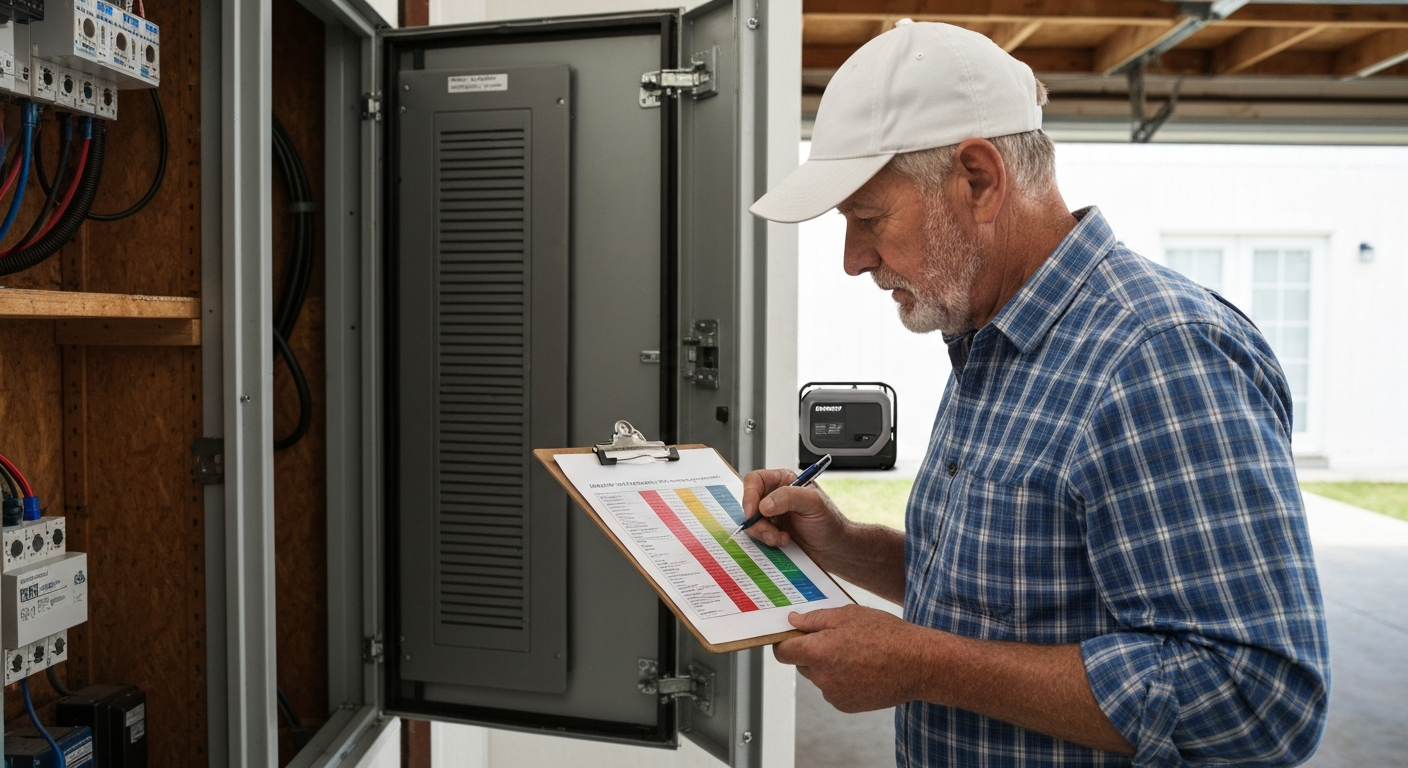
Buying a generator that is too small leaves critical systems unpowered. Buying one that is too large wastes thousands of dollars. Proper load calculation takes about 20 minutes and ensures you get it right the first time.
Step 1: List Your Critical Loads
Write down everything you want to power during an outage. Be honest, most Puerto Rico homeowners want to run AC, and that changes everything.
Step 2: Find the Wattage of Each Appliance
| Appliance | Running Watts | Starting Watts |
|---|---|---|
| Central AC (2 ton) | 1,500 | 4,500 |
| Central AC (3 ton) | 2,200 | 6,600 |
| Central AC (4 ton) | 3,000 | 9,000 |
| Refrigerator | 150 | 600 |
| Electric water heater | 4,000 | 4,000 |
| Propane water heater | 0 | 0 |
| Microwave | 1,000 | 1,000 |
| Lights (LED, whole home) | 300 | 300 |
| Television | 100 | 100 |
| Internet router/modem | 20 | 20 |
| Sump pump | 800 | 1,300 |
| Medical equipment (CPAP) | 30-60 | 30-60 |
| Washing machine | 500 | 1,500 |
⚡ Dato clave
Propane water heaters use zero electricity to heat water. Switching from electric to propane water heating reduces your generator load requirement by up to 4,000 watts, allowing you to buy a smaller, less expensive generator.
Step 3: Calculate Running Load
Add all running watt values for appliances you plan to run simultaneously.
Example:
- Central AC (3 ton): 2,200W
- Refrigerator: 150W
- Lights: 300W
- TV and router: 120W
- Total running load: 2,770W = 2.77 kW
Step 4: Account for Starting Load
Motors require 2-3x their running wattage to start. Your generator must handle the highest starting surge, typically your AC compressor.
Example:
Highest starting surge (3-ton AC): 6,600W.
Your generator must handle at least 6,600W starting capacity.
Step 5: Add 20% Safety Margin
Multiply your running load by 1.2 to avoid running the generator at maximum capacity continuously.
Example:
2,770W × 1.2 = 3,324W needed, plus ability to handle 6,600W starting surge.
Recommended generator: 16-20 kW.
✓ Recomendación
Never size your generator at exactly your calculated load. Running a generator at 90-100% capacity continuously shortens engine life significantly. Always add the 20% safety margin.
Quick Reference by Home Size
| Home Size | Loads Included | Recommended kW |
|---|---|---|
| Small / essential only | Fridge, lights, fans, router | 7-11 kW |
| Medium / with one AC | 1 AC, fridge, lights, appliances | 14-18 kW |
| Large / whole home | Multiple AC units, all appliances | 20-30 kW |
| Commercial | Full commercial load | 30-48 kW+ |
Common Mistakes in Load Calculation
- 1.Forgetting starting watts, the most common error. Always check motor starting surge, not just running watts.
- 2.Planning for today, not tomorrow, if you are adding an AC unit in the next few years, size for that now.
- 3.Ignoring the electric water heater, at 4,000W it is often the biggest single load. Switching to propane eliminates it.
- 4.Undersizing to save money, a generator running at capacity continuously will fail prematurely.
Not sure what size you need?
Call Tropigas for a free home evaluation to find the perfect generator size.
Call 787-641-8002Frequently Asked Questions

Ing. Rodolfo Leo Quiñones
Gerente de Operaciones, Ventas y Exportaciones — Tropigas / Tropigas SXM
Expert in propane energy systems, NFPA compliance, and industrial gas logistics in Puerto Rico and the Caribbean.