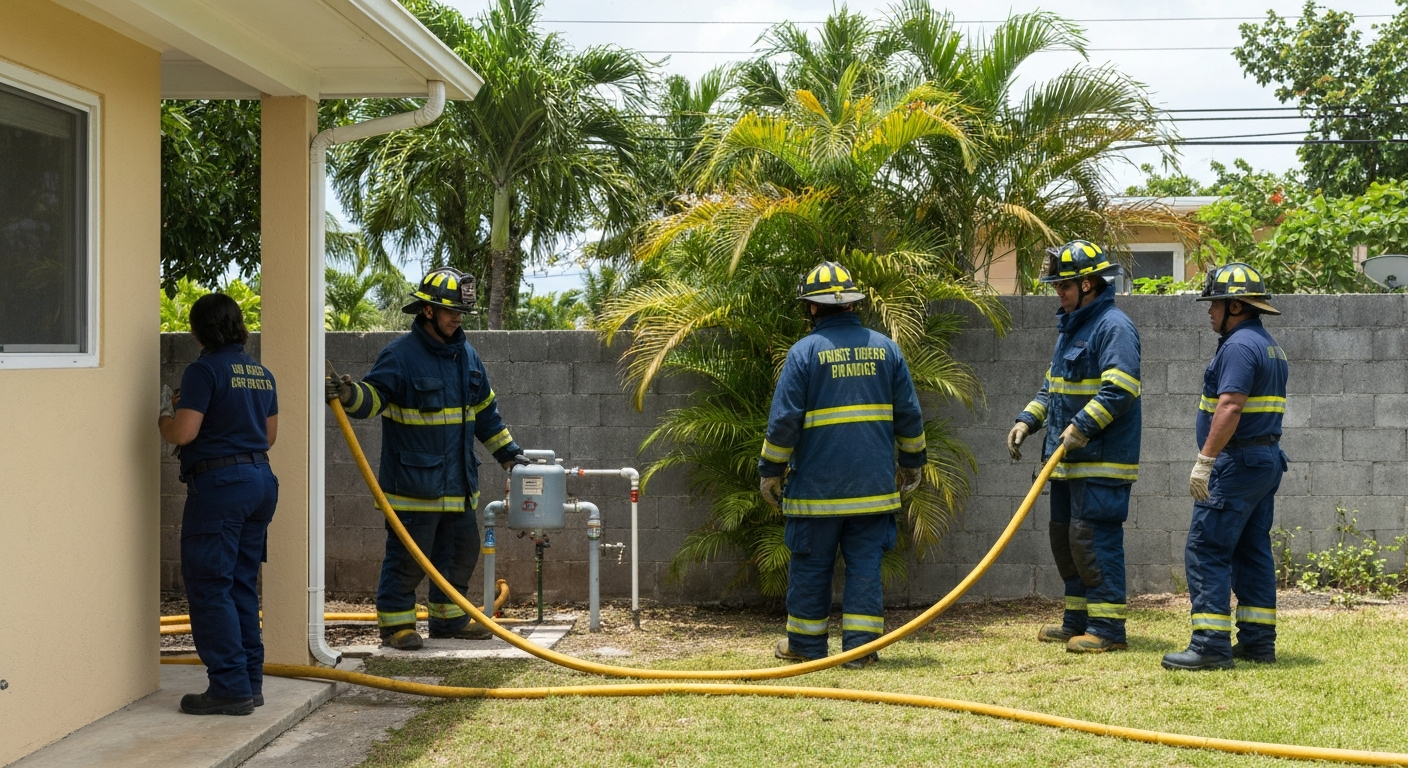
What should first responders know about propane emergencies in Puerto Rico, and how does Tropigas support emergency response operations? When a propane emergency occurs in Puerto Rico, fire departments, police, and emergency medical services are the first on scene. Understanding how propane behaves in emergency situations, what resources are available to first responders, and how Tropigas coordinates with emergency services protects both responders and the community. This page provides propane emergency information for first responders and for property owners who want to understand the emergency response process.
For propane emergency support in Puerto Rico, call Tropigas at 787-641-8002. For active emergencies, call 911 first.
CHEMTREC Emergency Response Support
CHEMTREC (Chemical Transportation Emergency Center) provides 24-hour emergency response support for hazardous materials incidents including propane. Tropigas is registered with CHEMTREC under CCN692055. First responders and emergency coordinators can call CHEMTREC at 1-800-424-9300 at any time to access propane-specific emergency response guidance, safety data sheets, and expert consultation during an active incident.
CHEMTREC provides real-time guidance to help first responders make informed decisions about evacuation zones, approach strategies, and hazard management for propane incidents. Call 1-800-424-9300 (CCN692055) for CHEMTREC support.
How Propane Behaves in Emergency Situations
Understanding propane's physical properties helps first responders manage propane emergencies safely. Propane is heavier than air and will sink and accumulate in low-lying areas, drains, and basements rather than dispersing upward. This means evacuation zones must account for ground-level propane accumulation in areas downwind and downhill from the incident. Propane vapor ignites at concentrations between 2.1 and 9.5 percent in air (the flammable range). Below 2.1 percent, it will not ignite. Above 9.5 percent, it is too rich to ignite but the concentration may drop into the flammable range as it disperses.
Propane tanks involved in fires are subject to BLEVE (Boiling Liquid Expanding Vapor Explosion) risk and should be approached with extreme caution. Call CHEMTREC at 1-800-424-9300 for real-time guidance.
Propane Tank BLEVE Risk
A BLEVE (Boiling Liquid Expanding Vapor Explosion) is one of the most serious risks in a propane fire scenario. A BLEVE occurs when a propane tank is exposed to external fire, causing the liquid inside to rapidly vaporize and the tank to fail catastrophically, releasing and igniting a large propane fireball. Warning signs of impending BLEVE include relief valve discharge from the tank, flame impingement directly on the tank shell, and visible discoloration or deformation of the tank.
First responders should maintain a safe distance from any propane tank involved in fire, apply water to cool the tank shell if safe to do so from a protected position, and never approach a tank with flame impingement without full protective equipment and CHEMTREC guidance. Call 1-800-424-9300 for BLEVE guidance.
Evacuation Zone Guidelines
When a propane incident occurs, establishing the correct evacuation zone protects the public and first responders. For a leaking propane tank without ignition, the initial evacuation zone should extend at least 100 to 300 feet in all directions as a starting point, with adjustment based on wind direction, terrain, and incident size. Propane accumulates in low areas, so evacuation of basements, drainage areas, and low-lying spaces downwind is critical. For a propane tank involved in fire, evacuation zones of 500 feet or more may be appropriate depending on tank size.
First responders should use CHEMTREC guidance at 1-800-424-9300 and local incident command protocols to determine specific evacuation zones.
How Tropigas Supports Emergency Response
Tropigas works alongside first responders during propane emergencies in Puerto Rico in several ways. Our 24-hour emergency line at 787-641-8002 connects first responders and property owners with Tropigas technical staff who can provide installation-specific information, tank size and fill level data for known customer locations, certified technicians for emergency shutoff and tank assessment after the scene is secured, and coordination of post-incident inspection and return-to-service authorization.
Tropigas does not respond to active emergency scenes as primary responders. We support the incident commander and certified first responders with technical expertise and follow-up service.
Post-Incident Procedures
After a propane emergency is resolved by first responders, several steps must occur before the propane system can be returned to service. Tropigas certified technicians must inspect the tank, valves, and all piping for damage from heat, impact, or pressure stress. Any damaged components must be repaired or replaced before the system is refilled. A new NTSP inspection may be required depending on the scope of damage. Tropigas coordinates with property owners to complete post-incident inspection and clearance as efficiently as possible.
Call 787-641-8002 after any propane incident to schedule post-incident inspection.
Frequently Asked Questions
Ing. Rodolfo Leo Quiñones
Gerente de Operaciones, Ventas y Exportaciones
Expert in propane energy systems, NFPA compliance, and industrial gas logistics in Puerto Rico and the Caribbean.