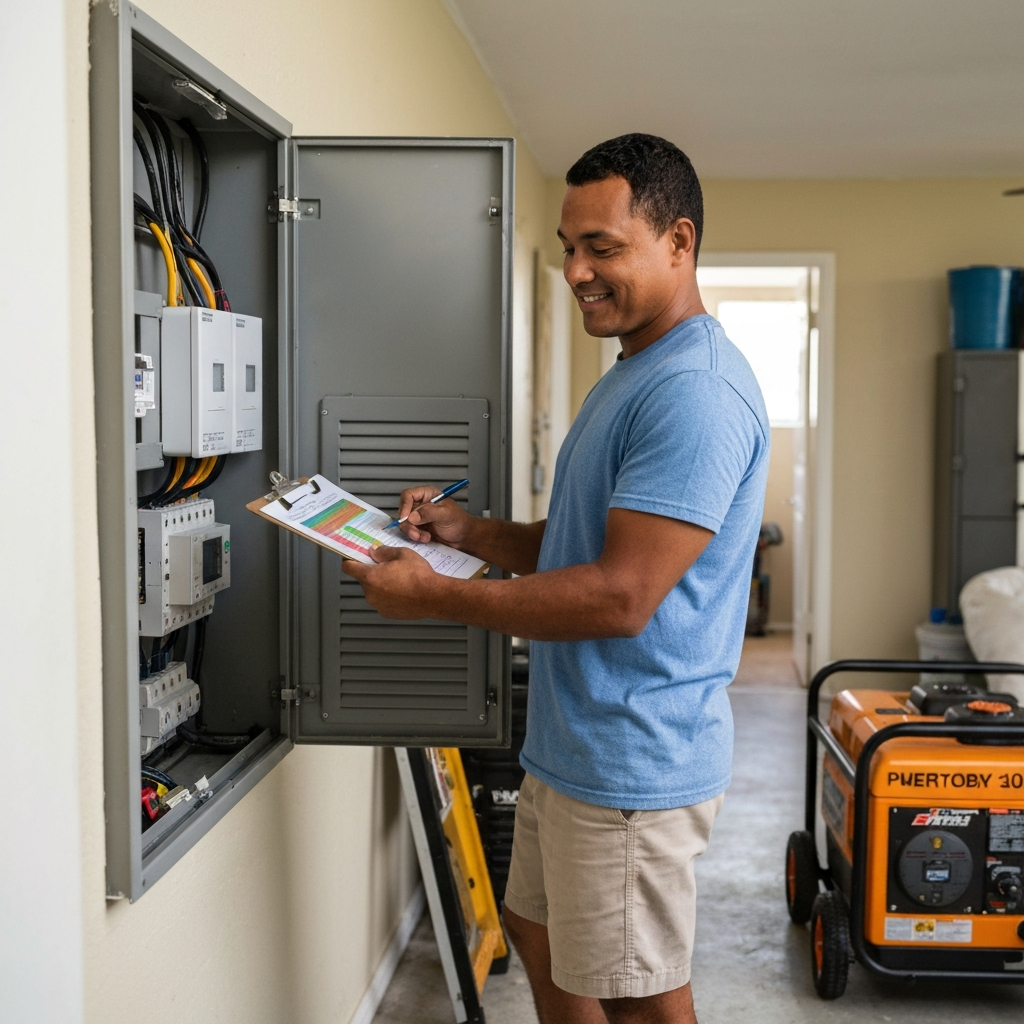
Choosing the wrong generator size is one of the most expensive mistakes Puerto Rico homeowners make in their backup power planning. Too small and your generator overloads trying to run your home, causing equipment damage and power failures. Too large and you've spent thousands more than necessary on a unit that runs inefficiently.
This guide walks you through the exact calculation process that Tropigas engineers use when sizing propane generator systems for Puerto Rico homes.
Step 1: List Your Essential Appliances
Start by deciding which appliances you want to power during an outage. Most Puerto Rico homeowners fall into one of three categories:
Basic coverage (keep food cold, minimal lighting):
Refrigerator, a few LED lights, phone charging, ceiling fans.
Comfort coverage (livable during extended outages):
Refrigerator, several lights, ceiling fans, TV, phone charging, internet router, small AC unit.
Full home coverage (normal life during outages):
Everything, including central AC, all lights, all appliances, electric water heater (if applicable), security system, medical equipment.
Step 2: Calculate Your Wattage Requirements
Every electrical appliance has a wattage rating, found on its nameplate or in its manual. For generator sizing, you need two numbers: running watts and starting watts.
- Running watts: The power the appliance uses during normal operation.
- Starting watts: The extra power surge needed when a motor starts, typically 2x to 3x the running watts for motor-driven appliances.
Your generator must handle the highest starting watt surge that can occur simultaneously.
Common Puerto Rico Home Appliance Wattages:
| Appliance | Running Watts | Starting Watts |
|---|---|---|
| Central AC, 2 ton | 2,500 | 7,500 |
| Central AC, 3 ton | 3,500 | 10,500 |
| Central AC, 5 ton | 6,000 | 18,000 |
| Window AC, 12,000 BTU | 1,200 | 2,400 |
| Window AC, 18,000 BTU | 1,800 | 3,600 |
| Refrigerator | 700 | 2,200 |
| Chest freezer | 500 | 1,500 |
| Water pump | 1,000 | 3,000 |
| Electric water heater | 4,500 | 4,500 |
| Microwave | 1,000 | 1,000 |
| LED lights (per bulb) | 10 | 10 |
| Ceiling fan | 75 | 75 |
| TV, 55 inch | 150 | 150 |
| Internet router | 20 | 20 |
| CPAP machine | 30 to 60 | 30 to 60 |
| Nebulizer | 300 | 300 |
Step 3: Calculate Your Total Load
- For running watts: Add up the running watts of all appliances you plan to run simultaneously.
- For starting watts: Identify your largest motor-driven appliance (usually your AC system) and add its starting watts to the running watts of everything else.
Example calculation for a typical Puerto Rico home:
Running loads:
- Central AC (3 ton): 3,500 W
- Refrigerator: 700 W
- Lights (10 LED bulbs): 100 W
- Ceiling fans (3): 225 W
- TV and router: 170 W
- Total running: 4,695 W
Starting surge (AC startup): 10,500 W starting, minus 3,500 W already running = 7,000 W additional surge.
Peak starting load: 4,695 + 7,000 = 11,695 W
This home needs a generator capable of handling at least 11,695 watts starting load, which points to a 13 kW or larger generator.
Step 4: Apply the Right Sizing Buffer
Generator manufacturers recommend running generators at 70% to 80% of their rated capacity for optimal efficiency and longevity. This means you should size your generator larger than your calculated load.
Required generator size = Total peak load / 0.75
For the example above: 11,695 / 0.75 = 15,593 W, pointing to a 16 kW generator as the practical recommendation.
Simplified Sizing Guide for Puerto Rico Homes
| Home Size and Configuration | Recommended Generator Size |
|---|---|
| Small home, no AC, essential loads only | 7 kW |
| Small to medium home, window AC units | 10 kW |
| Medium home, small central AC (2 ton) | 13 kW |
| Medium home, central AC (3 ton) | 16 kW |
| Large home, central AC (3 to 5 ton) | 20 kW |
| Large home, heavy loads, multiple AC units | 22 to 30 kW |
| Commercial or industrial | 30 kW+ |
The Propane Connection: Generator Size Affects Tank Size
Once you know your generator size, your propane tank size follows directly. Larger generators consume more propane per hour, requiring larger tanks for equivalent outage coverage.
A 13 kW generator requires a 250 to 500-gallon tank for practical hurricane season coverage. A 20 kW generator requires a 500-gallon tank minimum, with 1,000 gallons recommended for extended outage scenarios. This is why the generator sizing and tank sizing conversations happen together during your Tropigas site evaluation.
Get a Free Home Load Evaluation
Call 787-641-8002 for a free home load evaluation. Our engineers will calculate your exact wattage requirements, recommend the right generator size, and design the complete propane fuel system for your home.
Call 787-641-8002 to ScheduleIng. Rodolfo Leo Quiñones
Operations, Sales and Export Manager , Tropigas / Tropigas SXM
Expert in propane energy systems, NFPA compliance, and industrial gas logistics in Puerto Rico and the Caribbean.